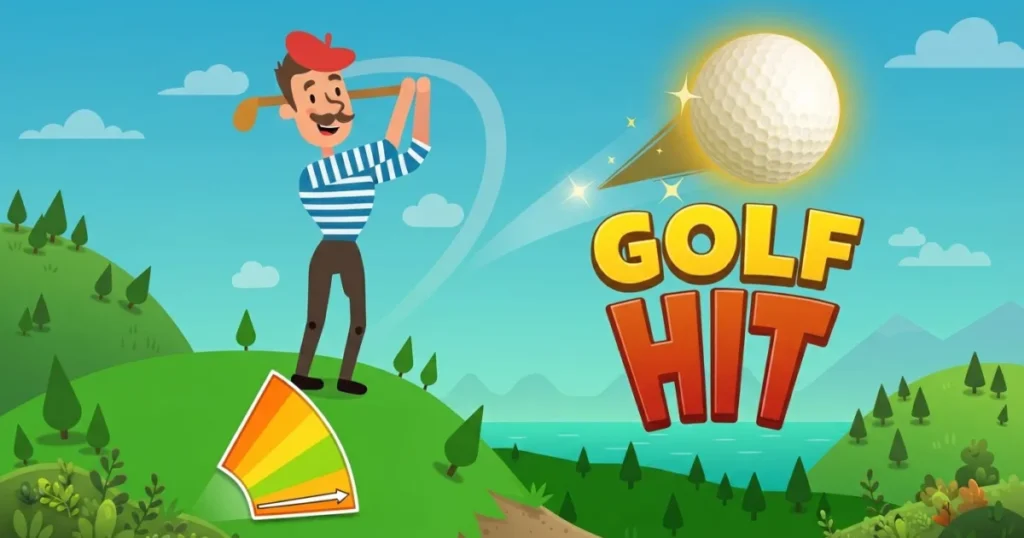









Golf Hit transforms traditional mini golf into a physics-driven arcade experience where every shot launches your ball through platformer-style courses. Released in October 2025 by QuietGames, this Unity-powered game strips away the slow pace of conventional golf and replaces it with fast, momentum-based challenges that demand precision timing and spatial awareness. Each level presents a new arrangement of obstacles, ramps, and hazards that turn simple putting into a test of trajectory calculation and reflexes.
Table of Contents+
- Movement Controls & Input Mechanics for Golf Hit
- Stage Progression & Level Acts Architecture
- Hazards, Traps & Physics Mechanics
- Platforms
- Is Golf Hit offline?
- Gameplay Video
- Golf Games
- Classic Gold Made Simple
- Golf with a Twist
- Alternative Golf Games
- What are Golf Games?
- Cozy Golf
- Mini Golf Club
- Playing a Match
- Essential Tips to Beat Difficult Stages
- Where to Play Golf Hit
- Similar Games You’ll Enjoy
- For Parents
- FAQs About Golf Hit
- Start Your Golf Hit Challenge
Movement Controls & Input Mechanics for Golf Hit
Golf Hit uses a streamlined control scheme built around mouse aiming and click-based shooting. Players position their cursor to set the angle and direction of each shot, then left-click to launch the ball. The longer you hold the click, the more power you apply to the shot, creating a simple but effective system for controlling distance and velocity. This mouse-driven approach works smoothly across Chrome, Edge, and Firefox browsers without requiring any downloads or plugins.
Power management becomes critical as you progress through later stages. Overcharging a shot can send your ball careening off-platform into the void, while underpowered hits leave you stranded short of checkpoints. Learning to gauge the exact click duration for each situation separates successful runs from repeated restarts.
Keyboard & Desktop WASD Controls
Desktop play relies entirely on mouse input for aiming and shooting. The left mouse button handles both shot preparation and execution, letting you adjust your angle in real time before committing to the launch. Right-click functionality provides secondary aiming assistance, helping you line up complex bank shots or calculate bounces off angled surfaces.
Shift key activation triggers a boost mechanic during certain levels, adding extra velocity to shots when you need to clear large gaps or reach elevated platforms. This boost system recharges between uses, forcing you to plan when to spend your speed advantage versus when to conserve it for upcoming obstacles.
Touch Screen & Mobile Navigation
Mobile controls translate the desktop experience into touch-friendly inputs. Tap and hold anywhere on the screen to begin charging your shot, with a visual power meter showing your current force level. Drag your finger to adjust aim direction before releasing to fire, giving you the same precision as mouse controls but adapted for touchscreen responsiveness.
The drag-and-release mechanic feels natural on phones and tablets, with the game automatically scaling hit zones for finger-sized inputs. Touch controls maintain the same physics calculations as desktop, ensuring mobile players face identical challenges without any mechanical disadvantages.
Stage Progression & Level Acts Architecture
Golf Hit structures its campaign around discrete level acts, each introducing new platform configurations and obstacle patterns. Early stages teach basic shot mechanics through straightforward layouts with minimal hazards, gradually layering in moving platforms, rotating barriers, and precision-required landing zones. Progression follows a linear path where completing one level unlocks the next, building mechanical complexity as your skills develop.
Each act contains multiple individual holes that must be completed in sequence. Missing a platform or falling off the course resets you to the last checkpoint, preserving your progress through the level’s earlier sections. This checkpoint system rewards consistent execution while preventing single mistakes from erasing entire runs.
Reaching Checkpoints & Hard Mode Unlocks
Checkpoints appear as glowing markers positioned at key intervals throughout each level. Landing your ball on a checkpoint platform saves your position, letting you respawn there if subsequent shots fail. Strategic checkpoint usage becomes essential in longer levels where multiple difficult shots chain together, as skipping a checkpoint to save time can backfire if you miss the next platform.
Hard mode unlocks after completing the standard campaign, remixing existing levels with tighter tolerances and additional hazards. These remixed stages remove some checkpoints and introduce faster-moving obstacles, demanding near-perfect shot execution. Hard mode serves as the endgame challenge for players who’ve mastered the base mechanics and want to test their skills against unforgiving layouts.
Hazards, Traps & Physics Mechanics
Golf Hit fills its courses with physics-based hazards that interact with your ball’s momentum and trajectory. Rotating blades sweep across platforms at timed intervals, requiring you to calculate safe launch windows. Bounce pads amplify your ball’s velocity in specific directions, turning controlled shots into high-speed ricochets that can either save strokes or send you flying off-course.
Gravity wells and magnetic fields warp your ball’s flight path mid-air, bending trajectories around obstacles or pulling shots toward danger zones. These environmental forces add a puzzle element to shot planning, as you must account for how external physics will modify your intended path. Mastering these interactions separates efficient runs from trial-and-error approaches.
Sloped surfaces alter ball behavior on landing, with steep inclines causing rolls and slides that continue long after initial impact. Flat platforms provide stable stopping points, but angled surfaces can redirect your momentum in unexpected ways. Learning to predict post-landing movement helps you position shots for optimal next-hit angles.
Platforms
Platform variety defines Golf Hit’s level design philosophy. Static platforms provide reliable landing zones, while moving platforms require timing-based shots that account for their position at ball-arrival time. Disappearing platforms vanish seconds after your ball lands, forcing immediate follow-up shots before your footing evaporates.
Breakable platforms shatter on impact, giving you only one chance to use them as stepping stones toward your goal. These fragile surfaces appear in puzzle-focused levels where shot order matters as much as accuracy. Choosing which breakable platform to sacrifice first becomes a strategic decision that affects your available routes through the remaining course.
Is Golf Hit offline?
Golf Hit requires an active internet connection to load and play, as the game streams through your web browser from Arcazi.com. The Unity-based architecture pulls game assets and level data from online servers, preventing offline functionality. However, once a level loads completely, temporary connection drops won’t immediately interrupt gameplay, though you’ll need to reconnect to save progress or advance to new stages.
Browser caching stores some game elements locally after your first session, reducing load times on subsequent visits. This partial caching doesn’t enable true offline play but does improve performance on slower connections by minimizing redundant downloads.
Gameplay Video
Watching experienced players tackle Golf Hit’s advanced levels reveals optimization strategies that aren’t obvious during casual play. Video demonstrations showcase how top performers chain together bank shots, use boost timing to skip entire platform sequences, and exploit physics interactions to reach seemingly impossible landing zones. These recordings highlight the skill ceiling hidden beneath the game’s accessible surface mechanics.
Community-created video guides break down specific level solutions, offering multiple approach strategies for challenging stages. Studying these videos helps identify which obstacles can be bypassed versus which require direct engagement, saving time during your own attempts.
Golf Games
Golf Hit belongs to the broader category of golf-inspired arcade games that prioritize momentum and physics over realistic simulation. Unlike traditional golf games focused on club selection and swing mechanics, this subgenre emphasizes trajectory planning and environmental interaction. The golf framework provides familiar context while the actual gameplay explores platforming and puzzle-solving through a sports lens.
This hybrid approach attracts players who enjoy both sports games and precision platformers, offering the satisfaction of sinking difficult shots without the slower pace of simulation golf. The genre’s appeal lies in its ability to deliver quick, skill-testing challenges that feel rewarding without demanding extensive golf knowledge.
Classic Gold Made Simple
Golf Hit distills golf’s core appeal into its simplest form by focusing exclusively on the moment of impact and ball flight. Removing elements like terrain reading, wind calculation, and club management lets the game concentrate on pure shot execution. This streamlined design philosophy makes each level a focused test of aiming skill rather than a multi-variable puzzle.
The minimalist approach extends to visual presentation, with clean geometric platforms and clear obstacle markers that communicate gameplay information instantly. This clarity prevents confusion during fast-paced sequences where split-second decisions determine success or failure.
Golf with a Twist
The platformer integration transforms Golf Hit from a standard golf game into something mechanically distinct. Traditional golf games simulate realistic ball physics on grass and sand, but this game treats platforms as discrete landing zones separated by void space. Missing your target doesn’t mean a penalty stroke in rough terrain but rather a complete level restart, raising the stakes for every shot.
This twist on golf conventions creates tension absent from simulation-focused titles. Each shot carries real consequence, and the platforming element introduces verticality and three-dimensional space navigation that flat golf courses can’t provide. The result feels more like a precision action game that happens to use golf mechanics as its core interaction model.
Alternative Golf Games
Players seeking similar experiences might explore other physics-based golf titles that emphasize arcade action over realism. Games focusing on trick shots, environmental manipulation, and momentum-based challenges share Golf Hit’s design philosophy while offering different mechanical twists. The key commonality across these alternatives is their treatment of golf as a vehicle for creative problem-solving rather than sport simulation.
Some alternatives lean harder into puzzle elements with static layouts requiring specific shot sequences, while others emphasize speed and reflex-based challenges. Golf Hit occupies a middle ground, blending both approaches into levels that reward both planning and execution skill.
What are Golf Games?
Golf games as a genre span from hyper-realistic simulations replicating professional tournament conditions to abstract arcade experiences using golf mechanics as jumping-off points for creative gameplay. The simulation end focuses on accurate physics, course recreation, and strategic club selection, appealing to players seeking virtual versions of real-world golf.
Arcade golf games like Golf Hit prioritize entertainment and accessibility over realism, using golf’s basic premise as a framework for diverse mechanical experiments. This spectrum gives players options ranging from serious sports simulation to casual physics puzzlers, all unified by the core concept of getting a ball from start to finish in minimal strokes.
Cozy Golf
Golf Hit’s fast-paced, consequence-heavy gameplay contrasts sharply with the cozy golf subgenre that emphasizes relaxation and low-pressure exploration. Where cozy golf games feature forgiving mechanics, soothing aesthetics, and no-fail conditions, Golf Hit demands precision and punishes mistakes with level restarts. This difference in design philosophy creates distinct player experiences despite sharing golf-inspired mechanics.
The tension in Golf Hit comes from its platforming DNA, where falling means restarting rather than simply adding strokes to your score. This high-stakes approach appeals to players seeking challenge and mastery rather than the meditative experience cozy golf games provide.
Mini Golf Club
Mini golf’s influence on Golf Hit appears in the game’s emphasis on obstacle navigation and creative course design. Traditional mini golf courses use windmills, loops, and ramps to create memorable holes, and Golf Hit translates these concepts into three-dimensional platform arrangements. The core appeal remains identical: finding the optimal path through a designed challenge using limited shots.
However, Golf Hit’s platforming element adds consequence absent from physical mini golf. Real mini golf lets you retrieve balls from failed shots and try again from the same position, while Golf Hit’s digital format enforces stricter rules where mistakes reset your progress. This digital adaptation intensifies the challenge while maintaining mini golf’s puzzle-solving spirit.
Playing a Match
Single-player progression in Golf Hit revolves around completing increasingly difficult level sequences. Each match against the course tests your ability to chain together successful shots across multiple platforms without falling. The game tracks your stroke count per level, encouraging optimization and replay to achieve par or better scores.
Competitive elements emerge through score comparison rather than direct multiplayer. Players can challenge themselves to beat developer-set par scores or compete informally by comparing completion times and stroke counts with friends. This asynchronous competition maintains focus on individual skill improvement while providing external motivation through performance benchmarks.
Essential Tips to Beat Difficult Stages
Power calibration makes the difference between successful shots and frustrating restarts. Spend time in early levels learning how click duration translates to ball velocity, building muscle memory for common distance requirements. This foundational skill pays dividends in later stages where precise power control becomes mandatory for threading shots through tight gaps.
Study platform layouts before taking your first shot. Identifying the critical path through a level lets you plan shot sequences that position your ball optimally for subsequent hits. Rushing into shots without surveying the full course often results in successful early hits that leave you with impossible follow-up angles.
Checkpoint prioritization saves time and frustration in longer levels. Always aim to land on checkpoint platforms even if it costs an extra stroke, as the insurance against future mistakes outweighs the score penalty. Skipping checkpoints to chase perfect runs only makes sense once you’ve already completed a level and understand all its challenges.
Boost timing requires practice to master. Save your Shift-key boosts for situations where normal shot power can’t reach the target, rather than using them immediately when available. Many levels include sections specifically designed around boost usage, and wasting your boost early can leave you unable to progress past these mandatory boost zones.
Bank shots off angled surfaces extend your effective range and open alternate routes through levels. Experiment with ricochets during practice runs to discover which surfaces provide reliable bounces versus which absorb momentum unpredictably. Mastering bank shots turns seemingly impossible platform gaps into manageable challenges.
Where to Play Golf Hit
Golf Hit is free to play right now on Arcazi.com in your browser with no download required. Also available on Google Play for Android.
Similar Games You’ll Enjoy
- Geometry Dash Lite – Rhythm-based platforming that tests your timing reflexes through music-synced obstacle courses.
- Geometry Dash Meltdown – Fast-paced geometric challenges where precision jumping meets electronic soundtrack intensity.
- A Dance Of Fire And Ice – Rhythm game requiring perfect timing as you guide two orbiting spheres through musical patterns.
- Paper Minecraft – 2D recreation of block-building survival with crafting, mining, and creative construction.
- Sprunki Phase 2 – Music creation game letting you mix beats and melodies through character-based sound layering.
- Tekken 3 – Classic fighting game featuring diverse martial artists in competitive one-on-one combat.
These selections showcase the variety available in the Music category and beyond.
For Parents
Golf Hit presents physics-based platforming challenges without violent content or mature themes. The game focuses on trajectory calculation and precision aiming through abstract geometric environments. Gameplay involves launching a golf ball across platforms using mouse clicks, with failed attempts resulting in level restarts rather than any graphic consequences. The skill-based progression and puzzle-solving elements make it appropriate for players developing spatial reasoning and timing coordination.
FAQs About Golf Hit
How hit golf ball?
Position your mouse cursor to set the shot angle, then left-click and hold to charge power. Release the click to launch the ball toward your target platform. The longer you hold, the more velocity you apply to the shot.
How hit golf ball straight?
Align your cursor directly along the intended path before clicking. Avoid moving the mouse during the power charge phase, as cursor drift during charging can introduce unwanted angle changes that send shots off-target.
How hit golf ball further?
Hold the left mouse button longer to increase shot power, or use the Shift key boost when available for maximum distance. Boost shots travel significantly farther than standard hits but require recharge time between uses.
How hit golf driver?
Golf Hit doesn’t use traditional club selection. All shots use the same hitting mechanism with power controlled by click duration. Focus on power calibration rather than equipment choice to achieve driver-like distance.
How hit golf ball higher?
Angle your cursor upward before launching to create an arcing trajectory. Higher angles sacrifice horizontal distance for vertical clearance, useful for reaching elevated platforms or clearing tall obstacles.
How hit golf irons?
The game uses a unified shot system without club differentiation. Adjust your power level through click duration to achieve iron-like control for shorter, more precise shots versus full-power drives.
How drive golf ball?
Maximize click hold duration and aim at a shallow upward angle for optimal distance. Combining full power with efficient trajectory angles produces the longest drives possible within the game’s physics system.
How drive golf cart?
Golf Hit focuses exclusively on ball-hitting mechanics and doesn’t include cart driving or course navigation elements. Gameplay centers entirely on shot execution across platformer-style levels.
Can I save my progress in Golf Hit?
Progress saves automatically as you complete levels, with the game tracking your furthest unlocked stage. Browser cookies store this data locally, so clearing browser data will reset your progress.
Does Golf Hit have a two-player mode?
The game offers single-player progression only. Competitive elements come from comparing scores and completion times with other players rather than direct multiplayer matches.
What happens when I miss a platform?
Missing a platform causes your ball to fall into the void, triggering an immediate level restart from your last reached checkpoint. Checkpoints preserve progress through earlier sections of longer levels.
How do I unlock hard mode levels?
Complete the entire standard campaign to unlock hard mode. These remixed stages feature tighter tolerances, additional hazards, and fewer checkpoints, designed for players who’ve mastered base mechanics.
Start Your Golf Hit Challenge
Golf Hit delivers physics-driven platforming wrapped in accessible golf mechanics, playable instantly in your browser on Arcazi.com. No downloads, no waiting, just pure shot-making skill across increasingly creative courses. Launch your first ball and discover how far precision and timing can take you.