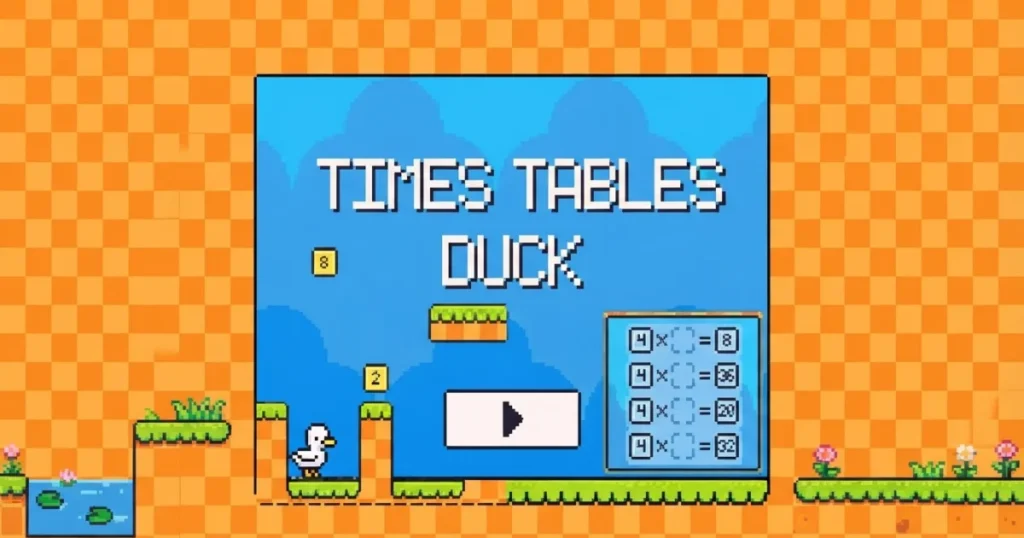














Times Table Duck combines fast-paced platforming with multiplication practice in a browser game that challenges both your reflexes and your math skills. You control a determined duck racing through obstacle-filled rooms, solving equations under pressure while collecting keys and avoiding hazards. Developed by Coolmath Games and released in September 2022, this HTML5 title turns times table drills into an adrenaline-fueled escape challenge. The game runs smoothly on both desktop and mobile devices, making it accessible wherever you need a quick math workout.
Table of Contents+
What is Times Table Duck?
Understanding the Core Concept
Times Table Duck is an educational platformer that merges multiplication practice with time-trial gameplay. Each level presents you with one or more multiplication equations displayed in the top left corner of the screen. Your duck must navigate platforms, collect numbered tiles that form the correct answer, grab a key that appears once you solve the equation, and reach the exit door before a ten-second timer expires. The game features 15 levels that progressively increase in difficulty, introducing more complex platform layouts, additional hazards like spikes, and multi-step equation sequences that demand quick mental math and precise movement.
The core loop revolves around speed and accuracy. You cannot simply memorize routes because the equations change, forcing you to calculate answers on the fly while simultaneously planning your path through each room. This dual-layer challenge makes times table duck game sessions feel more like action puzzles than traditional educational drills. The numbered tiles you need to collect are scattered across platforms at varying heights, so reaching the correct answer often requires jumping, dodging obstacles, and backtracking under intense time pressure.
Is “Math Duck” or “Multiplication Duck” the Same Game?
Yes, Math Duck and Multiplication Duck are alternative names for the same game. Players searching for math playground times table duck or times table duck cool math games are all looking for this specific title. The game appears under different names across various educational game platforms, but the core mechanics remain identical: solve multiplication problems, collect the key, and escape within ten seconds. The official title used by the developer is Times Table Duck, though the community often shortens it to Math Duck for convenience.
The Primary Goal in Each Level
Your objective in every level is threefold: solve the multiplication equation displayed at the top of the screen by collecting the numbered tiles that form the correct answer, grab the key that spawns once you complete the equation, and reach the exit door before the countdown timer hits zero. The game enforces a strict sequence when multiple equations appear on screen. You must solve the top equation first, then work your way down through any additional problems before the key becomes available. Missing this order or collecting wrong numbers resets your progress, costing precious seconds and often forcing a level restart.
Mastering the Controls
Keyboard Controls: WASD and Arrow Key Options
Desktop players can choose between two control schemes. The WASD keys offer movement with W for jumping, A for moving left, D for moving right, and S typically unused in this game. Alternatively, the Arrow Keys provide identical functionality with Up for jumping, Left and Right for horizontal movement, and Down rarely needed. Both schemes respond instantly, which is critical when you need to change direction mid-jump or quickly reverse course after realizing you’re heading toward the wrong number tile. The game runs smoothly in Chrome, Edge, and Firefox without requiring any plugins or additional software.
Touchscreen Controls for Mobile Devices
Mobile players use on-screen touch controls that appear as directional buttons overlaid on the game screen. Tap the left and right arrows to move your duck horizontally, and tap the jump button to leap over gaps and obstacles. The touch interface is responsive enough for precise platforming, though some players find the ten-second time limit more challenging on mobile due to the slightly slower input response compared to physical keyboards. The game automatically adapts its layout to fit smartphone and tablet screens, maintaining readability for both the equations and the numbered tiles you need to collect.
Core Gameplay Mechanics
Navigating Platforms and Obstacles
Each level in times table duck multiplication features multi-tiered platform layouts with numbered tiles placed at strategic locations. You must jump between platforms of varying heights, avoid spike traps positioned on floors and walls, and sometimes backtrack when you realize the number you need is behind you. The platforming demands precision because touching spikes instantly restarts the level, erasing any progress you made on solving the equation. Some rooms include narrow ledges that require careful timing to land on safely, while others feature wide gaps that test your understanding of the duck’s jump arc and momentum.
Environmental hazards become more prevalent in later levels. Spikes appear in clusters that force you to take longer routes around them, and some platforms are positioned just barely within jumping range, requiring you to leap from the very edge to reach them. The game never introduces moving platforms or enemies, keeping the focus on static obstacle courses that you must navigate while simultaneously doing mental math. This design choice ensures that the challenge comes from multitasking rather than from unpredictable elements that could feel unfair under the strict time limit.
How the Timer Works for Multiplication Problems
The ten-second countdown begins the instant a level loads, giving you no grace period to survey the room or plan your route. This timer applies to the entire level, not to individual equations, so if a level contains multiple multiplication problems, you must solve all of them and reach the exit within that single ten-second window. The timer displays prominently on screen and ticks down in real time, creating constant pressure that forces you to make split-second decisions about which path to take and whether you have time to correct a mistake.
When the timer reaches zero, the level immediately restarts from the beginning, resetting the equation, the key, and your duck’s position. There are no checkpoints or partial credit for getting close to the exit. This all-or-nothing approach makes every second count and rewards players who can quickly recall multiplication facts without hesitation. The timer does not pause if you stop moving, so standing still to think through a problem is rarely a viable strategy unless you’re absolutely certain of your answer and just need a moment to plan your final approach to the exit.
Consequences of Incorrect Answers
Collecting the wrong numbered tiles has immediate consequences. If you grab numbers that do not form the correct answer to the displayed equation, the key will not appear, and you cannot progress to the exit. The game does not explicitly punish you with a game-over screen for wrong answers, but the wasted time spent collecting incorrect tiles almost always results in the timer expiring before you can backtrack and find the right numbers. This indirect penalty system teaches players to double-check their mental math before committing to a path, as reversing course in a platformer under time pressure is extremely difficult.
When multiple equations appear in sequence, solving them out of order also blocks progress. The game requires you to complete the top equation first, then move down to subsequent problems. Attempting to skip ahead or solve equations in reverse order prevents the key from spawning, effectively trapping you in the level until the timer runs out. This mechanic reinforces the importance of reading the screen carefully and following the prescribed order, adding a layer of procedural thinking on top of the raw multiplication practice.
Collecting the Key to Progress
The key only appears after you successfully collect all the numbered tiles that form the correct answer to every equation in the level. It spawns at a fixed location, usually near the center of the room or along the path to the exit door. Once visible, you must physically move your duck to the key’s position to collect it, which often requires additional platforming and careful navigation around any obstacles between your current position and the key. The key does not come to you automatically, so poor positioning after solving an equation can leave you scrambling to reach it before time expires.
After grabbing the key, the exit door unlocks, and you must reach it to complete the level. The door is typically placed at the far end of the room, requiring one final sprint or series of jumps. Even with the key in hand, you can still fail the level if the timer hits zero before you touch the door. This final dash adds a last burst of tension to each stage, especially in later levels where the exit might be positioned behind additional spike traps or across difficult jumps that demand perfect execution under pressure.
Level Structure and Times Table Coverage
Total Number of Levels in the Game
Times Table Duck contains 15 levels in total, each designed to test a different combination of multiplication facts and platforming challenges. The early levels feature simple single-digit multiplication with straightforward platform layouts, while later stages introduce larger numbers, multi-step equation sequences, and more complex obstacle courses. The difficulty curve is gradual but noticeable, with levels 10 through 15 demanding both strong multiplication recall and advanced platforming skills to complete within the ten-second limit.
Which Times Tables are Practiced Across Levels
The game covers a wide range of times tables, focusing primarily on the multiplication facts from 2x through 12x that form the foundation of elementary math curricula. Early levels concentrate on smaller tables like 2x, 3x, and 5x, which most players find easier to recall quickly. As you progress, the game introduces equations from the 6x, 7x, 8x, and 9x tables, which are statistically the most challenging for students to memorize. The final levels mix problems from across the entire range, including the notoriously difficult 7×8, 8×7, 9×6, and similar combinations that require solid fluency to solve under time pressure.
Option to Select Specific Times Tables for Practice
Times Table Duck does not include a custom practice mode or level select feature that allows you to isolate specific multiplication tables. The game follows a fixed linear progression where you must complete each level in sequence to unlock the next. This structure ensures comprehensive coverage of all times tables rather than allowing players to avoid their weak areas. While some educational games offer targeted practice modes, this title prioritizes a curated difficulty curve that gradually builds fluency across all multiplication facts through repeated exposure in varied contexts.
Educational Benefits and Target Audience
How Times Table Duck Supports Learning Multiplication
The game reinforces multiplication fluency through high-pressure repetition that mimics the quick recall needed in real-world math applications. By forcing players to solve equations within seconds while simultaneously managing platforming challenges, Times Table Duck builds automaticity in multiplication facts. This dual-task design prevents rote memorization without understanding, as players must genuinely know their times tables to succeed rather than simply pattern-matching or guessing. The immediate feedback loop of success or failure helps identify weak areas, and the engaging gameplay format reduces the tedium often associated with traditional flashcard drills.
Research in educational game design suggests that embedding skill practice within goal-oriented challenges improves retention compared to isolated drills. Times Table Duck applies this principle by making multiplication the gatekeeper to progression rather than the sole focus. Players develop mental math speed naturally because the game rewards quick calculation, and the variety of equations across levels prevents over-reliance on memorizing specific problem sets. The ten-second timer also trains students to work efficiently under test conditions, building confidence for timed assessments in classroom settings.
Recommended Age Group for Players
The game targets elementary and middle school students, typically ages 7 through 12, who are actively learning or reinforcing their multiplication tables. Younger players in second or third grade can benefit from the early levels that focus on simpler times tables, while older students in fourth through sixth grade will find the later levels appropriately challenging. The platforming mechanics are accessible enough for children with basic gaming experience, though very young players who struggle with keyboard or touchscreen coordination may find the ten-second time limit frustrating until they develop faster reflexes.
Ensuring a Safe Gaming Experience for Kids
Times Table Duck is a browser-based educational game with no social features, chat functions, or external links that could expose children to inappropriate content. The game contains no violence, mature themes, or advertising beyond the hosting platform’s standard interface. Parents and teachers can confidently use this title in classroom or home settings as a supplementary math tool. The straightforward gameplay and clear educational focus make it suitable for unsupervised play, though younger children may benefit from adult guidance when first learning the controls or understanding the equation-solving sequence required in multi-step levels.
Strategies for Success
Tips to Increase Speed on Challenging Levels
Memorize the visual layout of each level during your first attempt, even if you fail. Knowing where numbered tiles are positioned before the level starts allows you to plan an efficient route that minimizes backtracking. Practice your times tables outside the game to reduce the mental processing time needed for each equation. The faster you can recall that 7×8 equals 56, the more time you have to focus on platforming. When multiple equations appear, quickly scan all of them before moving to identify which numbers you need to collect first, preventing wasted movement toward tiles you don’t need yet.
Use the full ten seconds strategically by moving immediately when the level loads rather than pausing to think. Your brain can process the equation while your hands execute basic movement, so start heading toward the general area where answer tiles tend to cluster. In levels with spike traps, prioritize safe routes over fast routes when you’re still learning the layout. A slightly slower path that avoids restarts will always beat a risky shortcut that kills you halfway through. Once you’ve mastered a level’s obstacles, then optimize for speed by cutting corners and taking calculated risks on tight jumps.
Efficient Key Acquisition Techniques
Position yourself near the center of the room after collecting the final numbered tile, as keys typically spawn in central locations. This reduces the distance you need to travel once the key appears. In multi-equation levels, solve problems in a path that naturally leads you toward the likely key spawn point rather than zigzagging across the entire room. Watch for visual cues in the level design, such as open platforms or clear pathways, that often indicate where important items like keys will appear.
After grabbing the key, immediately orient yourself toward the exit door and start moving. Do not pause to celebrate or check the timer, as every fraction of a second matters in the final dash. If you know a level well, you can sometimes pre-position yourself so that collecting the key and reaching the exit become one continuous movement without direction changes. This advanced technique requires memorizing both the key spawn location and the exit door position, but it can shave crucial seconds off your completion time in the toughest levels.
Where to Play Times Table Duck
You can play Times Table Duck free right now on Arcazi.com in your browser with no download required.
Games Like Times Table Duck
If you enjoyed the fast-paced challenge of Times Table Duck, these action-packed platformers and skill games offer similar thrills:
- Vex 6 – Navigate deadly obstacle courses with precision jumps and split-second timing in this hardcore stickman platformer.
- Duck Duck Clicker – Build a duck empire through incremental clicking and strategic upgrades in this addictive idle game.
- Run 3 – Race through gravity-defying tunnels in space, dodging gaps and mastering momentum-based movement.
- Pizza Tower – Speed through chaotic levels with explosive action and combo-driven gameplay in this retro-inspired platformer.
- Vex 8 – Test your reflexes in the latest installment of the brutal platforming series with new traps and challenges.
- Vex 5 – Master wall jumps and slide mechanics while avoiding spikes and saw blades in this skill-based platformer.
These titles deliver the same blend of quick reflexes and strategic thinking that makes Math games so engaging.
For Parents
Times Table Duck is a purely educational platformer designed to reinforce multiplication skills through timed challenges. The game contains no violent content, mature themes, or social interaction features. All gameplay revolves around solving math problems and navigating obstacle courses with cartoon-style graphics. The difficulty comes from time pressure and platforming precision rather than any inappropriate material, making it suitable for elementary and middle school students practicing their times tables in both classroom and home environments.
FAQs About Times Table Duck
How do I play Times Table Duck on mobile devices?
Use the on-screen touch controls to move left and right, and tap the jump button to leap over obstacles. The game automatically adapts to touchscreen input on smartphones and tablets.
Can I skip levels in Times Table Duck?
No, the game follows a linear progression where you must complete each level in sequence to unlock the next. There is no level select or skip feature.
What happens if I collect the wrong numbers?
The key will not appear if you collect incorrect numbered tiles, and you’ll waste valuable time that usually results in the timer expiring before you can correct your mistake.
How many seconds do I have to complete each level?
You have exactly ten seconds from the moment the level loads to solve all equations, collect the key, and reach the exit door.
Does Times Table Duck save my progress?
Progress typically saves in your browser’s local storage, allowing you to resume from the last level you completed when you return to the game.
Which multiplication tables does the game cover?
The game covers times tables from 2x through 12x, with early levels focusing on simpler facts and later levels mixing problems from across the entire range.
Can I practice specific times tables?
No, Times Table Duck does not include a custom practice mode. You must play through the fixed level sequence that covers all multiplication facts progressively.
What are the controls for desktop players?
Use either WASD keys or Arrow Keys to move your duck, with W or Up to jump, A or Left to move left, and D or Right to move right.
Why won’t the key appear in my level?
The key only spawns after you collect all the correct numbered tiles that form the answer to every equation on screen, and you must solve them in order from top to bottom.
Is Times Table Duck free to play?
Yes, the game is completely free and playable directly in your browser with no download, registration, or payment required.
What age group is Times Table Duck designed for?
The game targets elementary and middle school students ages 7 through 12 who are learning or reinforcing their multiplication tables.
Can I play Times Table Duck offline?
No, the game requires an active internet connection to load and play, as it runs through your web browser on the hosting platform.
Start Your Math Challenge Now
Times Table Duck is free to play instantly in your browser on Arcazi.com with no download needed. Jump in and test your multiplication skills against the clock right now.