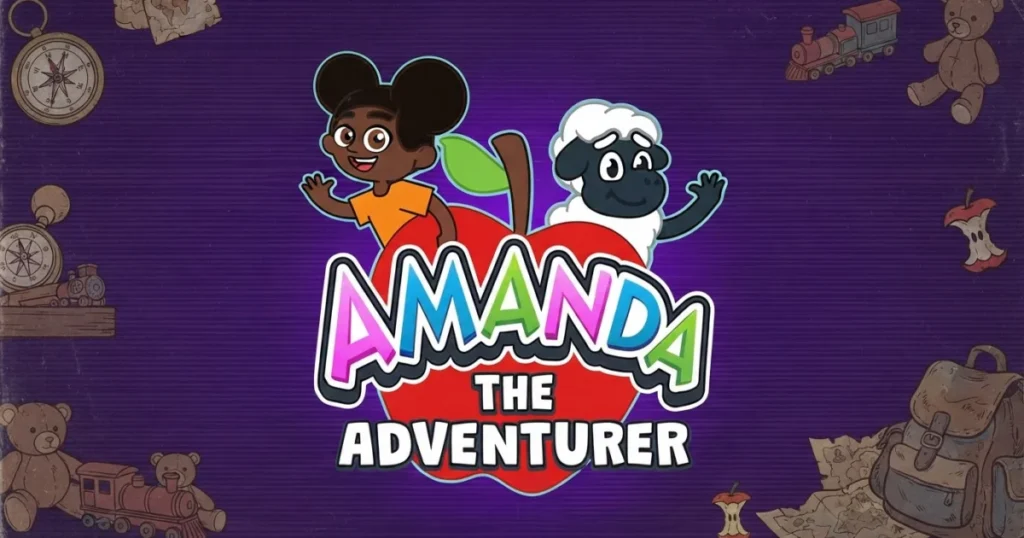











Arcazi.com brings you Amanda The Adventurer, a found footage horror game that transforms innocent children’s television into psychological terror. You inherit a collection of VHS tapes featuring Amanda and her sidekick Wooly, but something sinister lurks beneath the cheerful surface. Each tape you watch pulls you deeper into a mystery where the line between viewer and participant dissolves. Parents should note this game contains disturbing themes and psychological horror elements discussed in the For Parents section below.
Table of Contents+
- What Is Amanda The Adventurer?
- How to Play Amanda The Adventurer?
- Unraveling the Found Footage Horror
- The Core Gameplay Loop: Tapes, Puzzles, and Discovery
- Exploring Amanda The Adventurer’s Multiple Endings
- The Development Journey and Future of Amanda The Adventurer
- Where to Play Amanda The Adventurer
- More Horror Games to Explore
- For Parents
- FAQs About Amanda The Adventurer
- Start Your Investigation Now
What Is Amanda The Adventurer?
Amanda The Adventurer started as an entry for the Found Footage Jam before DreadXP expanded it into a full release. The game places you in a dusty attic filled with VHS tapes starring Amanda, an animated girl who leads educational adventures alongside Wooly the sheep. What begins as nostalgic children’s programming quickly reveals unsettling behavior. Amanda breaks the fourth wall, addresses you directly, and reacts to your responses in ways that feel disturbingly aware. The tapes are not recordings anymore; they become interactive interrogations where refusing to participate has consequences.
This horror adventure blends puzzle solving with narrative exploration. Between tapes, you search the attic for objects that unlock new footage and reveal the story of who created these tapes and why they were hidden. The game’s strength lies in its restraint, building dread through subtle wrongness rather than jump scares. Amanda’s cheerful voice takes on menacing undertones when you give the wrong answer, and Wooly’s nervous glances suggest he knows more than he can say.
How to Play Amanda The Adventurer?
Playing Amanda The Adventurer requires both observation and interaction across two distinct spaces. The attic serves as your hub where you physically explore and manipulate objects. The VCR and television become your portal into Amanda’s world, where typing correct answers determines your progression. Success depends on noticing environmental clues in both spaces and understanding that Amanda’s questions often have darker implications than their surface-level phrasing suggests.
The game runs smoothly in Chrome, Edge, and Firefox without requiring downloads or plugins. Mouse controls handle all attic navigation and object interaction, while your keyboard becomes essential during tape playback when Amanda demands typed responses. Paying attention to background details in both the tapes and the attic reveals connections that unlock the full story.
Navigating the Attic and Using the VCR
Use your mouse to look around the attic space and click on objects to examine or pick them up. The VCR sits at the center of your investigation; clicking on it lets you insert tapes you find scattered around the room. Some tapes are immediately visible, while others only appear after you solve puzzles or watch specific footage. Clicking the VCR’s play button starts the tape, and you can eject tapes by clicking the eject control when you need to explore further or switch to a different recording.
Attic exploration follows a loop: watch a tape, receive new information or objects, search the space for newly accessible items, then return to the VCR with your findings. Certain objects in the attic only become interactive after Amanda references them in her show. A locked box might remain inert until Amanda mentions a specific word or concept, at which point clicking it reveals new tapes or clues. This interconnected design means you cannot brute-force progression by clicking everything; you must engage with the tapes to unlock the attic’s secrets.
Interactive Puzzles and Typing Mechanics
When Amanda asks a question during tape playback, a drawing board appears on screen. Type your answer using your keyboard and press Enter to confirm. Simple questions like “What do we need to bake a pie?” seem straightforward until you realize Amanda reacts differently to synonyms, refuses certain answers, or becomes hostile when you deliberately give wrong responses. The typing mechanic transforms passive viewing into active participation where your choices shape Amanda’s behavior and determine which story branches open.
Some puzzles require you to type words you discovered in the attic rather than obvious answers to Amanda’s questions. A name written on a photograph, a word hidden in background details, or a phrase from a previous tape might be the key to progressing past a seemingly simple riddle. Amanda’s reactions provide feedback: she becomes pleased with correct answers, frustrated with mistakes, and genuinely threatening when you type certain forbidden words. Learning which responses trigger which outcomes becomes part of the puzzle-solving process itself.
Unraveling the Found Footage Horror
The horror in Amanda The Adventurer operates on multiple layers. Surface-level unease comes from Amanda’s unnatural awareness and the show’s increasingly dark subject matter. Deeper terror emerges as you piece together what happened to the real people behind these tapes. The Amanda the Adventurer Wiki documents the extensive lore hidden in background details, tape timestamps, and environmental storytelling that reveals a tragedy far worse than haunted television.
Found footage horror works because it presents supernatural events through mundane technology. The VHS format, with its tracking lines and analog distortion, grounds the impossible in physical reality. When Amanda’s face glitches or her voice distorts, the effect feels like a corrupted recording rather than a digital effect. This aesthetic choice makes the horror feel discovered rather than manufactured, as if you genuinely stumbled upon something that should have stayed buried in that attic.
The Narrative, Lore, and Psychological Atmosphere
Amanda’s story unfolds through fragmented clues rather than explicit exposition. You learn about the show’s creator, the circumstances of its production, and the fate of the child actress who played Amanda through documents, photographs, and environmental details scattered across the attic. Wooly serves as a counterpoint to Amanda’s aggression, often trying to redirect conversations away from dangerous topics or warning you indirectly about consequences. His fear is palpable, suggesting he is trapped in the tapes alongside Amanda but lacks her power to break through.
The psychological atmosphere intensifies as Amanda’s questions become more personal and invasive. She stops asking about baking ingredients and starts asking about your name, your fears, and your intentions. The game creates discomfort by making you complicit; typing answers feels like feeding information to something that should not have access to it. Later tapes abandon educational pretense entirely, with Amanda directly addressing the mystery of her existence and demanding you help her in ways that feel increasingly dangerous. The narrative suggests that watching these tapes is not a passive investigation but an active ritual with real consequences.
The Core Gameplay Loop: Tapes, Puzzles, and Discovery
Each tape you watch in Amanda The Adventurer presents a self-contained episode with its own puzzle structure. Early tapes follow familiar children’s show formats: going to the store, visiting the farm, cooking in the kitchen. Amanda asks simple questions, you type simple answers, and the tape ends. These introductory episodes establish the baseline of normal behavior, making later deviations more disturbing. As you progress, episodes break format. Amanda ignores Wooly’s scripted lines, the show’s setting glitches into impossible spaces, and the questions stop having correct answers in any conventional sense.
Between tapes, attic exploration becomes increasingly complex. Objects you could not interact with earlier suddenly become relevant. A photograph reveals a name you need to type during a tape. A locked drawer opens after you watch specific footage, containing a tape that answers questions raised three episodes ago. This loop of watching, exploring, and connecting information creates a rhythm where progress feels earned through observation rather than handed to you through waypoints or tutorials.
Solving Amanda’s Riddles and Unlocking Secrets
Amanda’s riddles operate on multiple levels of interpretation. A question like “Where do we go when we’re hurt?” might accept “hospital” as a surface answer, but typing “nowhere” or “home” based on context clues from earlier tapes can unlock different responses and story branches. Some riddles require you to type words that are not answers at all but rather codes or names you discovered in the attic. A tape might show Amanda standing in front of a building with a partially visible sign; typing the complete business name you found on a document in the attic triggers a hidden response.
The game rewards players who test boundaries. Typing profanity, typing Amanda’s real name, or typing phrases that reference the show’s dark history produces unique reactions that reveal lore. Some secrets only unlock if you deliberately give wrong answers multiple times, pushing Amanda into states of anger that break her programming and expose the truth beneath. Other secrets require you to type nothing at all, letting timers run out to see what happens when you refuse to participate. This design encourages experimentation and multiple playthroughs to discover every hidden interaction.
Progression Through Attic Exploration
The attic changes as you progress through the tapes. New objects appear on shelves that were empty before. Locked containers open after you watch specific episodes. A photograph that seemed irrelevant early in the game becomes crucial evidence once you understand the full context. This environmental progression creates a sense that the attic itself is responding to your investigation, revealing information only when you are ready to understand it.
Certain progression gates require you to find physical objects hidden in the attic and use them correctly. A key might be tucked behind a stack of boxes, unlocking a drawer that contains a tape revealing Amanda’s origin. A note with a password lets you access a locked chest containing evidence of what happened to the show’s creator. These physical puzzles break up the tape-watching rhythm and force you to engage with the space as a real environment rather than just a menu for selecting videos. The attic becomes a character in its own right, a space that holds secrets and resists easy answers.
Exploring Amanda The Adventurer’s Multiple Endings
Amanda The Adventurer features multiple endings determined by your choices during key tape interactions and which secrets you uncover in the attic. The game does not explicitly signal when you are making a branching decision; instead, your accumulated responses and discovered objects determine which ending you receive. Some endings provide closure and answers, while others leave you with more questions and a sense that you made a terrible mistake. The Reddit community actively discusses ending variations and the specific triggers required to achieve each outcome.
Replayability comes from discovering how different choices lead to different conclusions. Typing a specific name during a critical moment might lead to an ending where you help Amanda, while refusing to type anything leads to an ending where you escape her influence. Finding all hidden tapes and objects unlocks a true ending that reveals the complete story, but reaching it requires thorough exploration and willingness to experiment with unconventional answers during tape playback.
Achieving Different Outcomes
The ending you receive depends on three factors: which tapes you watched, which objects you found in the attic, and how you answered Amanda’s most important questions. A completionist playthrough where you find every tape and object leads to the most comprehensive ending, but you can finish the game with partial information and receive a more ambiguous conclusion. Some endings are deliberately unsatisfying, reflecting the horror of incomplete understanding and the danger of dabbling in forces you cannot control.
Specific choices during late-game tapes have the most impact on your ending. When Amanda asks you to help her in the final episodes, typing “yes” versus “no” versus typing her real name produces three distinct outcomes. Finding a specific object in the attic before watching the final tape unlocks an additional ending option that is not available otherwise. The game encourages multiple playthroughs by making it impossible to see all content in a single run; certain tapes only appear if you made specific choices earlier, creating branching paths that require fresh starts to explore fully.
The Development Journey and Future of Amanda The Adventurer
DreadXP recognized the potential in the original jam game and partnered with the development team to expand Amanda The Adventurer into a full commercial release. The transition from a short experimental project to a complete horror experience involved deepening the lore, adding multiple endings, and expanding the attic exploration mechanics. The jam version introduced the core concept of interactive VHS horror, but the full release transformed it into a narrative puzzle game with substantial replay value and hidden depth.
Player reception focused on the game’s restraint and psychological approach to horror. Rather than relying on jump scares or gore, Amanda The Adventurer builds dread through wrongness and implication. The community has spent considerable effort documenting every hidden detail, secret interaction, and lore fragment, creating extensive resources for players who want to understand the complete story. This active community engagement demonstrates the game’s success at creating a mystery worth solving.
From Jam Game to Full Release
The original Found Footage Jam version of Amanda The Adventurer was a proof of concept that established the VHS horror aesthetic and Amanda’s unsettling personality. The full release expanded the tape library from a handful of episodes to a complete series with interconnected puzzles and narrative depth. Attic exploration became more complex, with multiple layers of hidden objects and environmental storytelling that were not present in the jam version. The typing mechanic was refined to recognize more varied inputs and provide more nuanced responses based on context.
DreadXP’s involvement brought production polish and marketing reach that allowed the game to find a wider audience. The full release launched on Steam and other platforms, introducing Amanda to players who might not have encountered the original jam entry. This transition from free experimental game to commercial product represents a successful path for indie horror developers: prove the concept in a jam, build community interest, then partner with a publisher to realize the full vision.
The Expanding Universe: Sequels and Lore
The success of Amanda The Adventurer led to sequel development that expands the universe and explores unanswered questions from the first game. Sequels introduce new tapes, new characters, and new layers of mystery while maintaining the core VHS horror aesthetic. Each installment adds to the lore without fully explaining everything, preserving the sense of mystery that made the original compelling. The expanding universe approach allows the developers to explore different aspects of Amanda’s story across multiple games rather than cramming everything into a single overstuffed narrative.
Future content continues to build on the foundation of interactive found footage horror. New games in the series experiment with the format, introducing different types of media beyond VHS tapes and exploring what happens to other people who encountered Amanda’s show. The lore suggests a larger conspiracy and supernatural framework that extends beyond a single haunted television program, giving the developers room to tell multiple stories within the same universe. This approach keeps the community engaged between releases as players theorize about connections and hidden meanings across the entire series.
Where to Play Amanda The Adventurer
Play Amanda The Adventurer free right now on Arcazi.com in your browser with no download required.
Also available on the App Store for iOS.
Also available on Google Play for Android.
More Horror Games to Explore
- Forsaken – Survive in an abandoned facility where every shadow hides a threat and escape requires solving environmental puzzles under pressure.
- Poppy Playtime – Navigate a toy factory where mascots have become monsters, using your GrabPack to solve puzzles and avoid deadly encounters.
- Slenderman – Collect pages in a dark forest while avoiding the faceless entity that stalks you, building tension through atmosphere and pursuit.
- Sprunki Phase 2 – Create music with animated characters in this rhythm game that takes a dark turn as you discover hidden horror elements.
- Vampire Survivors – Fight endless waves of monsters in this roguelike where strategic weapon combinations determine survival against overwhelming odds.
- Fnaf Sister Location – Work night shifts in an underground facility where animatronics hunt you through maintenance tunnels and party rooms.
These titles represent some of the best experiences in the Horror category available on the platform.
For Parents
Amanda The Adventurer contains psychological horror themes, disturbing imagery, and mature subject matter that may not be suitable for younger children. The game presents horror through implication and atmosphere rather than graphic violence, but the core narrative involves child endangerment, manipulation, and supernatural possession. The found footage format and VHS aesthetic create a sense of realism that can be more unsettling than obviously fictional horror. Parents should be aware that the game’s cheerful children’s show presentation is deliberately deceptive, and the actual content explores dark themes including death, loss of identity, and malevolent entities. The typing mechanic requires reading comprehension and the ability to interpret context clues, making it most appropriate for older teens and adults who can engage with psychological horror content.
FAQs About Amanda The Adventurer
How many amanda the adventurer games are there?
The series includes the original jam game, the full commercial release, and multiple sequels that expand the story and introduce new tapes and characters within the same universe.
How did amanda the adventurer die?
The game reveals through environmental clues and hidden tapes that Amanda was a real child actress whose fate became intertwined with the show itself through supernatural circumstances involving the production company.
How does amanda the adventurer end?
The ending depends on which tapes you watched, which objects you found in the attic, and how you answered critical questions during tape playback, with multiple possible conclusions ranging from escape to entrapment.
How does amanda the adventurer 3 ending?
The third game’s ending continues the overarching narrative while introducing new revelations about the tapes’ origin and Amanda’s true nature, with player choices determining the specific outcome achieved.
How many amanda the adventurer games will there be?
The developers continue expanding the universe with new installments that explore different aspects of the lore, with no announced final entry as the series remains active.
How many amanda the adventurer endings are there?
The first game features multiple distinct endings based on your choices, with additional variations depending on which secrets you discovered and how thoroughly you explored the attic.
How old amanda the adventurer?
Amanda appears as a young child in the tapes, but the game’s lore reveals complex details about her age and existence that are central to the horror narrative.
How was amanda the adventurer made?
The game originated as a Found Footage Jam entry before DreadXP partnered with the developers to expand it into a full commercial release with deeper mechanics and narrative.
Can I play Amanda The Adventurer on mobile devices?
Yes, the game supports touch controls on mobile devices with tap-to-interact functionality and on-screen keyboard input for typing answers during tape playback.
Do I need to watch all tapes to finish Amanda The Adventurer?
You can reach an ending without finding every tape, but discovering all hidden tapes and objects unlocks the true ending that provides the most complete understanding of the story.
What happens if I type the wrong answer in Amanda The Adventurer?
Wrong answers trigger different reactions from Amanda ranging from mild frustration to genuine hostility, and some wrong answers are required to unlock specific story branches and hidden content.
Does Amanda The Adventurer save my progress automatically?
The game saves your progress automatically after completing tapes and finding objects, allowing you to return to the attic and continue your investigation across multiple sessions.
Start Your Investigation Now
Amanda The Adventurer is free to play instantly in your browser on Arcazi.com with no download or installation required. Load the game, insert the first tape, and discover what secrets are hidden in the attic.