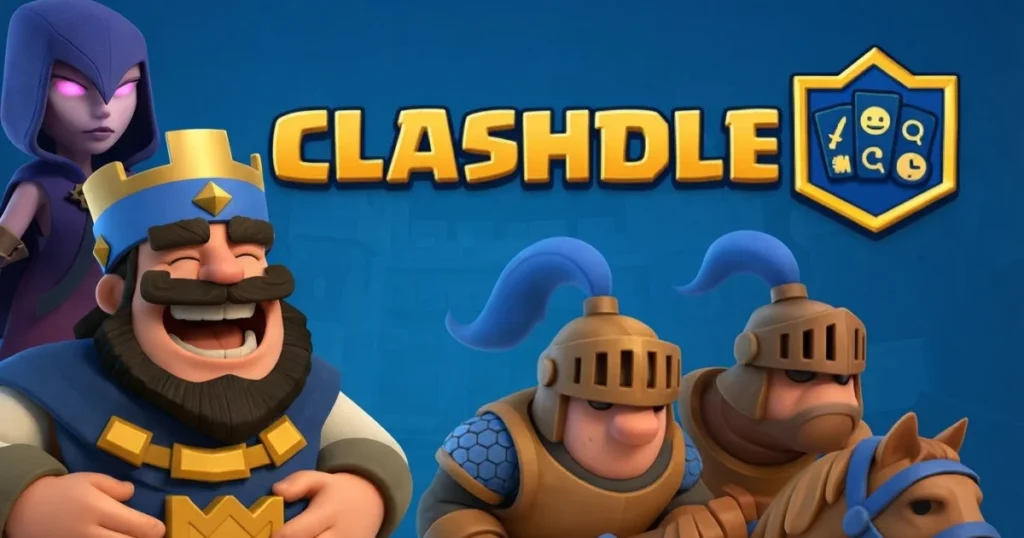




Clashdle is the daily card-guessing puzzle built for Clash Royale fans who want to put their deck knowledge to the test. Each round challenges you to identify a hidden Clash Royale card using attribute-based clues and color-coded feedback. Developed by Beedo Games and launched in 2025, it blends Wordle-style deduction with deep Clash Royale card knowledge. Playing once a day or grinding through unlimited rounds, the puzzle rewards anyone who knows their elixir costs, card rarities, and arena origins by heart.
Table of Contents+
- What Is clashdle?
- How to Play clashdle?
- Clashdle Game Modes and Progression
- Clash Royale Card Attributes and Deduction Metrics
- Advanced Strategies to Solve Puzzles in Fewer Guesses
- Where to Play clashdle
- More Puzzle and Trivia Games to Try
- For Parents
- FAQs About clashdle
- Put Your Clash Royale Knowledge to Work
What Is clashdle?
Clashdle is a trivia and puzzle game where players guess hidden Clash Royale cards by submitting guesses and reading the feedback on each attribute. Every guess reveals whether your chosen card’s elixir cost, rarity, card type, target type, range, and arena unlock are correct, too high, or too low. The goal is to narrow down the answer in as few guesses as possible.
The game was created under Supercell’s fan content policy, meaning it uses official Clash Royale card data while remaining a community-built project. Beedo Games released Clashdle in 2025, and it has continued to grow with updates through 2026. For players who live and breathe Clash Royale meta knowledge, this puzzle hits differently than a standard trivia quiz.
How to Play clashdle?
The core loop is straightforward: type a card name into the search field, submit your guess, and read the colored feedback to adjust your next attempt. Each attribute column lights up green for a correct match, yellow for a near miss on a numerical value, and red for an incorrect attribute. You keep guessing until you land on the right card or exhaust your attempts.
Input Selection and Card Search Mechanics
To guess a card, click the search bar and start typing the card’s name. A dropdown list appears with matching Clash Royale cards, and you select from that list rather than typing the full name freehand. This prevents typos from burning a guess and keeps the experience smooth on both mouse and touchscreen.
On desktop, the mouse handles all navigation: click to open the search bar, click to select a card from the dropdown, and click to confirm. Mobile players use tap to interact and touch screen gestures throughout. The game runs smoothly in Chrome, Edge, and Firefox without any additional setup required.
Color-Coded Feedback and Attribute Clues
After each guess, every attribute column for that card displays a color. Green means your guessed card shares that exact attribute with the hidden card. Red means the attribute does not match at all, and for numerical attributes like elixir cost, an arrow may appear alongside the color to signal whether the hidden card’s value is higher or lower than your guess.
Reading the feedback accurately is the entire skill of Clashdle. If your first guess returns green on rarity and card type but red on elixir and arena, you now have two confirmed constraints to build your next guess around. Stacking confirmed attributes guess by guess is how experienced players consistently solve the puzzle in three or four attempts.
Clashdle Game Modes and Progression
Clashdle offers distinct play modes that serve different types of players. The structure gives you one focused daily challenge alongside a way to keep practicing whenever you want more rounds.
Daily Challenge and Unlimited Mode
The Daily Challenge presents one hidden card per day, shared globally. Every player faces the same puzzle, which makes it easy to compare guess counts with friends or share your result on social media. Solving the daily challenge and seeing how few guesses you needed is the main social hook of the game.
For players who want more, clashdle unlimited mode removes the one-per-day restriction and lets you attempt as many puzzles as you like in a single session. Each new round pulls a fresh hidden card from the full Clash Royale card pool. This is the mode to use when you want to sharpen your deduction skills before the next daily challenge drops.
Pixel Mode Visual Identification
Pixel Mode swaps the attribute-feedback system for a visual challenge. The hidden card’s image is displayed in heavily pixelated form, and you must identify it purely from its blurred silhouette and color palette. Each incorrect guess progressively reveals a slightly cleaner version of the image, giving you more visual data the longer you struggle.
This mode tests a different kind of Clash Royale knowledge: visual familiarity with card artwork rather than stat memorization. Cards with distinctive silhouettes, like the Giant Skeleton or the Balloon, tend to be easier in Pixel Mode than smaller, similarly shaped troops. Training yourself to recognize pixel patterns is a separate skill from attribute-based deduction, and both modes complement each other well.
Clash Royale Card Attributes and Deduction Metrics
Every guess in Clashdle is evaluated across multiple card attributes simultaneously. Understanding what each attribute represents in Clash Royale terms is the foundation of fast, efficient solving.
Filtering by Elixir Cost, Rarity, and Card Type
Elixir cost is one of the most useful early filters because it spans a clear numerical range from 1 to 9. A single guess can immediately confirm or eliminate a large portion of the card pool based on elixir alone. Rarity splits cards into Common, Rare, Epic, and Legendary tiers, each with a significantly different card count, so confirming rarity early cuts the candidate list down fast.
Card type covers Troop, Spell, and Building, which are the three fundamental categories in Clash Royale. Confirming card type in your first guess removes roughly two-thirds of all possible answers from consideration. Combining a confirmed rarity and card type after one or two guesses leaves a manageable shortlist to work through systematically.
Narrowing Down Targets, Range, and Arena Origins
Target type tells you what a card can attack: Ground, Air, Both, or Buildings. Range separates melee cards from ranged ones, which maps closely to familiar Clash Royale archetypes. Arena origin indicates which arena a card first becomes available in, tying candidates to specific progression points in the base game.
Using these three attributes together is especially powerful in the mid-puzzle phase, once elixir and rarity are already confirmed. For a community discussion of how players approach building guess strategies across Supercell-themed puzzles, this Reddit thread on card-guessing formats offers useful perspective. Locking in target type plus range plus arena origin can bring your remaining candidate pool down to just two or three cards.
Advanced Strategies to Solve Puzzles in Fewer Guesses
Solving Clashdle efficiently means treating each guess as an information-gathering tool rather than a lucky shot. The best players think about attribute coverage per guess, not just whether a card feels plausible.
High-Information Opener Cards
Your first guess should maximize the number of attributes you can immediately confirm or eliminate. Cards with mid-range elixir costs (3 to 5 elixir), Common or Rare rarity, and Troop type cover the most statistically common combinations in the Clash Royale card pool. Starting with a card that hits those central values means any green feedback is highly actionable and any red feedback still eliminates a large block of candidates.
Avoid opening with niche cards like Legendary spells or 1-elixir troops. Sitting at the extremes of the distribution, these only confirm narrow, less useful data on the first pass. A solid mid-range opener funnels you toward the correct clashdle answer much faster than a dramatic or unconventional opening pick.
Eliminating Archetypes Through Stat Overlaps
Once you have two or three confirmed attributes from early guesses, shift your strategy to archetype elimination. Group the remaining candidates mentally by shared traits: all 4-elixir Rare Troops, for example, or all melee Ground-targeting Buildings. Your next guess should be a card sitting at the boundary between two such groups, so a single response resolves which group contains the hidden card.
This cross-referencing approach is what separates players who solve the puzzle in three guesses from those who need six or seven. Tracking confirmed attributes (green), ruled-out attributes (red), and which direction numerical arrows point lets you build a precise, shrinking candidate list with every submission. Practicing in Unlimited Mode is the fastest way to internalize these patterns before the next daily challenge resets.
Where to Play clashdle
Clashdle is free to play right now on Arcazi.com, directly in your browser with no download needed.
More Puzzle and Trivia Games to Try
If Clashdle has you hooked on logic-driven puzzle challenges, these titles are well worth a session:
- Sprunked – A creative music-mixing puzzle game with an offbeat cast of characters and deeply satisfying beat-building mechanics.
- Jewels Blitz 5 – A fast gem-matching puzzle game where chain reactions and precise combo timing drive every high score.
- Sprunki 2 – The follow-up to the original Sprunki, loaded with new sounds, characters, and layered composition challenges.
- Wheely 3 Race – A physics-based puzzle adventure starring a determined little car navigating cleverly designed obstacle levels.
- Tileman Io – A territory-claiming multiplayer game where you paint the map with movement and outlast every opponent on the board.
- Idle Ants – An idle strategy game where you grow a massive ant colony and watch your workers devour progressively larger objects.
All of these fit naturally alongside Clashdle in the Trivia and puzzle selection on Arcazi.com.
For Parents
Clashdle is a card-guessing trivia and puzzle game built around Clash Royale card knowledge. Gameplay centers on reading attribute clues and making logical deductions across categories like elixir cost, rarity, and card type. The mechanics are entirely puzzle-based, casual, and skill-focused. Players who enjoy strategy, card games, and logic challenges will find it a comfortable fit.
FAQs About clashdle
What is Clashdle?
Clashdle is a daily puzzle game where you guess hidden Clash Royale cards using color-coded attribute feedback across stats like elixir cost, rarity, card type, and arena origin. Developed by Beedo Games, it was released in 2025 under Supercell’s fan content policy.
How do I submit a guess in Clashdle?
Click the search bar, type part of a Clash Royale card’s name, and select the card from the dropdown list that appears. The puzzle evaluates your guess immediately and colors each attribute column to show how close you are.
What does green feedback mean in Clashdle?
Green means your guessed card shares that exact attribute with the hidden card. Red signals a mismatch, and numerical attributes like elixir cost may also display an arrow indicating whether the hidden card’s value is higher or lower than your guess.
What is Clashdle Unlimited mode?
Clashdle Unlimited removes the one-puzzle-per-day restriction and lets you play as many rounds as you want in a single session. Each new round draws a fresh hidden card from the full Clash Royale card pool.
What is Pixel Mode in Clashdle?
Pixel Mode challenges you to identify the hidden card from a heavily pixelated version of its artwork instead of attribute clues. Incorrect guesses progressively reveal a cleaner image to help you narrow down the answer.
What attributes does Clashdle compare for each guess?
Each guess is evaluated across elixir cost, rarity, card type (Troop, Spell, or Building), target type, range, and arena origin. All attributes are compared simultaneously and colored after every submission.
What is the best opening guess strategy in Clashdle?
Start with a card that has a 3 to 5 elixir cost, Common or Rare rarity, and Troop type. These central values cover the most statistically common card combinations and produce the most actionable feedback from a single guess.
How many guesses do I get in Clashdle?
The game challenges you to find the correct clashdle answer in as few guesses as possible. Experienced players typically aim to solve each puzzle within four to six attempts by using systematic attribute elimination.
Can I play Clashdle on a mobile device?
Yes. Mobile controls use tap to interact and touch screen gestures throughout the puzzle. No app installation is needed since the game runs fully in a mobile browser.
Does the Daily Challenge reset every day?
Yes. A new hidden card is presented each day, shared globally across all players. This shared puzzle makes it easy to compare your guess count with friends after both of you have played.
Is Clashdle free to play?
Clashdle is completely free to play in your browser. No account creation, download, or purchase is required to access either the Daily Challenge or Unlimited mode.
Who developed Clashdle?
Beedo Games developed and released Clashdle in 2025. The game was built under Supercell’s fan content policy, using official Clash Royale card data as its puzzle foundation.
Put Your Clash Royale Knowledge to Work
Clashdle is free, instant, and ready to play in your browser right now on Arcazi.com. No download needed, just open the game, pick your first guess, and see how few attempts it takes you to crack today’s card.