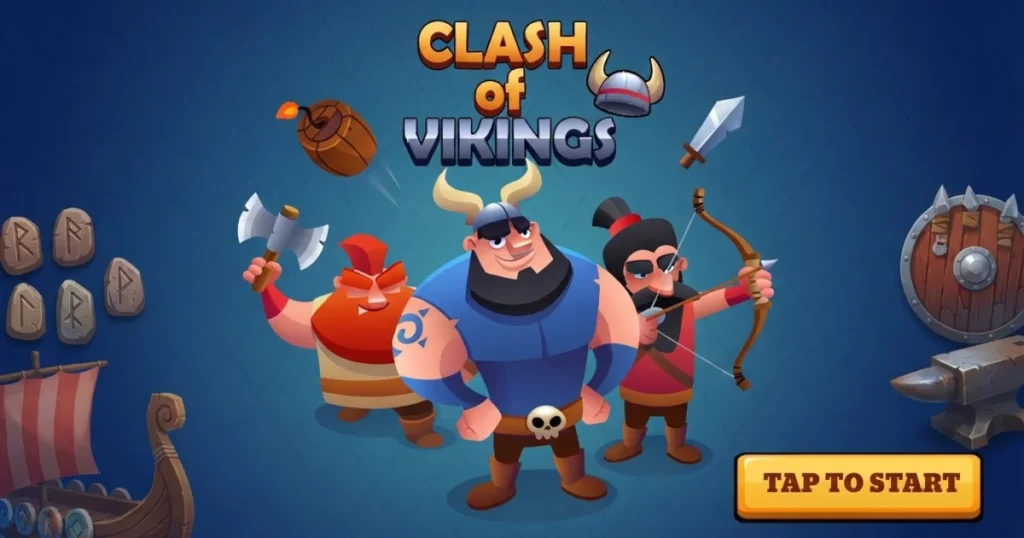











Clash Of Vikings drops you into fast-paced strategic battles where every card you play and every second you wait matters. Developed by Martijn Kunst, this tower defense card game challenges you to summon Viking warriors, launch devastating spells, and destroy your opponent’s towers before they flatten yours. Each match runs on a strict three-minute timer, forcing you to balance aggressive pushes with smart defensive plays across two lanes while managing a constantly regenerating elixir pool.
Table of Contents+
- What Is Clash Of Vikings?
- How to Play Clash Of Vikings?
- Deck Selection and Viking Unit Deployment
- Battlefield Layout and Tower Destruction Mechanics
- Advanced Battle Strategies and Winning Tactics
- Where to Play Clash Of Vikings
- More Strategic Tower Defense Games
- For Parents
- FAQs About Clash Of Vikings
- Start Your Viking Conquest Now
What Is Clash Of Vikings?
Clash Of Vikings is a real-time strategic card game built around lane-based tower destruction. You start each match with one main cannon tower and two defensive crown towers on your side of the battlefield. Your opponent mirrors this setup on the opposite end. Victory comes from destroying the enemy’s main cannon or both crown towers before time expires. The game draws heavy inspiration from mobile lane-push titles but strips the experience down to browser-friendly mechanics that work equally well on desktop and touchscreen devices.
Every battle in Clash Of Vikings revolves around deck management and elixir economy. You select a handful of Viking unit cards and spell cards before the match begins, then deploy them strategically during the fight. Units march forward automatically once summoned, attacking anything in their path. Spells like fireballs and arrow volleys let you deal direct damage to towers or clear clustered enemy troops. The elixir system regenerates slowly throughout the match, speeding up dramatically during the final 60-second overtime window when both players can flood the battlefield with units.
Matches unfold across two parallel lanes, each leading to one of your opponent’s crown towers. Splitting your forces between lanes forces your opponent to defend multiple fronts simultaneously, but overcommitting to one lane leaves you vulnerable to counter-pushes. The game rewards players who can read their opponent’s elixir count, predict incoming unit types, and deploy the right counter at the right moment. A single mistimed defensive play can cost you a tower, while a well-executed dual-lane push during overtime can end the match in seconds.
How to Play Clash Of Vikings?
The core gameplay loop revolves around dragging cards from your hand onto the battlefield. Each card represents either a Viking unit or a spell, and each costs a specific amount of elixir to deploy. Your elixir bar sits at the bottom of the screen, regenerating at a fixed rate throughout the match. Deploying a card drains elixir equal to its cost, so you need to balance aggressive spending with defensive reserves. Cards cycle through your hand automatically as you use them, pulling from your pre-built deck in a fixed rotation.
Unit cards spawn troops at the location you choose, and those troops immediately begin marching toward the nearest enemy structure. Melee units like axe-wielding berserkers charge straight into combat, while ranged units like archers hang back and fire from a distance. Spell cards activate instantly, dealing area damage or applying effects like slowing enemy units. The game runs smoothly in Chrome, Edge, and Firefox, with no performance hiccups even during chaotic late-game pushes when both players are spamming units across both lanes.
Desktop Controls and Mouse Positioning
On desktop, you control everything with the left mouse button. Click and hold a card in your hand, drag it to the battlefield position where you want to deploy it, then release to summon the unit or cast the spell. Positioning matters significantly because units spawn exactly where you drop the card. Placing a defensive unit too far forward wastes its potential to intercept enemy troops before they reach your towers. Placing a ranged unit too close to the enemy line gets it killed before it can fire more than a few shots.
The mouse cursor also determines spell targeting. Fireball spells require precise placement to hit clustered enemy units or deal chip damage to a tower. Arrow volleys cover a wider area but deal less damage per target, making them better for clearing swarms of low-health troops. You can queue multiple cards rapidly by dragging and releasing in quick succession, but each deployment still drains elixir, so spamming cards without a plan leaves you defenseless when your opponent counter-attacks.
Touchscreen Navigation and Drag-to-Release Mechanics
Mobile controls mirror the desktop experience but use touch gestures instead of mouse input. Tap and hold a card, drag your finger to the battlefield location, then lift to deploy. The touch interface responds instantly, letting you place units and cast spells as fast as you can drag. The game scales the battlefield to fit your screen, so even on smaller phones, you can still distinguish between lanes and target specific tower positions.
One advantage of touchscreen play is the ability to use multiple fingers for faster card cycling. You can hold one card with your thumb while dragging another with your index finger, though this requires enough elixir to deploy both. The drag-to-release mechanic also gives you a brief moment to reconsider placement before committing, since lifting your finger is the final confirmation. If you start dragging a card but realize you need to save elixir, you can drag it back to your hand area to cancel the deployment without penalty.
Deck Selection and Viking Unit Deployment
Before each match, you build a deck from the available Viking unit cards and spell cards. The game limits your deck size, forcing you to choose between unit diversity and spell utility. A balanced deck typically includes a mix of cheap, fast-deploying units for quick counter-attacks, tanky high-cost units for sustained pushes, and at least one or two spells for direct tower damage or crowd control. Your deck composition determines your strategic options during the match, so experimenting with different combinations is part of the learning curve.
Unit deployment timing is just as important as unit selection. Dropping a high-cost tank unit when your elixir is nearly empty leaves you unable to support it with backup troops, and your opponent can easily overwhelm it with cheaper counters. Conversely, saving too much elixir without deploying anything gives your opponent free reign to pressure your towers. The best players deploy units in waves, layering cheap troops behind expensive tanks to create a push that’s difficult to stop without spending significant elixir on defense.
Elixir Management and Summoning Mechanics
Elixir regenerates at a constant rate for the first two minutes of the match, then doubles in speed during the final 60-second overtime period. This creates a clear shift in pacing where early-game caution gives way to aggressive all-in pushes. During the standard phase, you regenerate roughly one elixir point every few seconds, meaning you can deploy a cheap unit every five to ten seconds or save up for a more expensive card. Wasting elixir by letting your bar sit at maximum capacity is one of the most common mistakes new players make.
The elixir system also introduces a risk-reward dynamic around card costs. Cheap units like basic Viking warriors cost only one or two elixir, letting you cycle through your deck quickly and maintain constant pressure. Expensive units like armored chieftains or spell cards like massive fireballs cost four or five elixir, delivering much higher impact but leaving you vulnerable if the play doesn’t pay off. Learning which cards counter which enemy units at the lowest elixir cost is the key to winning elixir trades and building an advantage over time.
Balancing Offense and Defense in Your Deck
A purely offensive deck packed with high-damage units and spells can overwhelm an unprepared opponent, but it collapses the moment you face a player who knows how to defend efficiently. Defensive cards like shield-bearing Vikings or area-denial spells let you stop enemy pushes without committing your entire elixir pool, leaving you with enough resources to counter-attack. The best decks include at least two or three cards specifically chosen for their defensive utility, even if they don’t contribute much to offensive pushes.
Balancing offense and defense also means understanding when to commit to a push and when to hold back. If your opponent just spent five elixir on a failed attack, you have a brief window where they can’t defend effectively. Dropping a fast unit in the opposite lane during this window forces them to choose between defending or accepting tower damage. Conversely, if you just defended a major push and your elixir is low, resist the temptation to immediately counter-attack. Wait for your elixir to regenerate enough to support your units, or your counter-push will die before it reaches the enemy towers.
Battlefield Layout and Tower Destruction Mechanics
The battlefield is divided into two parallel lanes, each leading to one of your opponent’s crown towers. The main cannon tower sits behind the crown towers, acting as the final objective. Destroying the main cannon wins the match instantly, regardless of how many crown towers remain. Destroying both crown towers also triggers an instant victory. If the three-minute timer expires with both main cannons still standing, the player who dealt more total tower damage wins. Ties are rare but possible if both players dealt identical damage.
Each tower has its own health pool and attack range. Crown towers fire at any enemy unit that enters their range, dealing moderate damage with each shot. The main cannon has a longer range and higher damage output, making it much harder to approach without overwhelming it with multiple units. Towers prioritize the closest enemy target, so placing a tanky unit in front of your weaker troops forces the tower to waste shots on the tank while your damage dealers chip away at the tower’s health from behind.
Defending Your Crown Towers
Crown towers are your first line of defense, and losing one opens up a direct path to your main cannon. Each crown tower covers one lane, so if an enemy unit destroys your left crown tower, your opponent can march units down that lane with minimal resistance. Defending crown towers requires deploying units in front of them to intercept enemy troops before they get within attack range. Placing defensive units too far forward wastes their potential, while placing them too close to the tower lets enemy units land several hits before your defenders engage.
Spell cards offer another defensive option when enemy units cluster near your towers. A well-placed fireball can wipe out a group of low-health troops in one hit, saving your tower from significant damage. Arrow volleys work similarly but cover a wider area with less damage per target, making them better for clearing swarms. The key to effective tower defense is spending the minimum elixir necessary to stop the push, leaving you with enough resources to launch a counter-attack while your opponent’s elixir is still recovering.
Executing Dual-Lane Pushes
Dual-lane pushes force your opponent to defend two lanes simultaneously, splitting their elixir and attention. The simplest dual-lane strategy is to deploy a cheap unit in one lane, wait for your opponent to commit defenders, then immediately drop a more expensive unit in the opposite lane. Your opponent now has to choose between letting the cheap unit chip away at one tower or ignoring the expensive unit that threatens the other tower. Either choice results in tower damage, and if they try to defend both lanes, they’ll drain their elixir and leave themselves open to follow-up attacks.
Dual-lane pushes are most effective during the overtime period when elixir regenerates twice as fast. You can deploy units in both lanes almost simultaneously, overwhelming your opponent before they can mount an effective defense. The risk is that if your dual-lane push fails, you’ll have spent most of your elixir and left yourself vulnerable to a counter-push. Timing is everything, so wait until your opponent has just spent elixir on defense or offense before launching your dual-lane assault. This ensures they won’t have enough resources to defend both lanes effectively.
Advanced Battle Strategies and Winning Tactics
Winning consistently in Clash Of Vikings requires more than just deploying units and hoping for the best. Advanced players track their opponent’s elixir count by mentally noting which cards they’ve played and estimating how much elixir they have available. If your opponent just deployed two expensive units, you know they’re low on elixir and vulnerable to a counter-attack. Conversely, if your opponent hasn’t played any cards for several seconds, they’re likely sitting at full elixir and waiting for you to commit to a push so they can counter it efficiently.
Another advanced tactic is cycling cheap cards to reach specific high-value cards in your deck faster. If you have a powerful spell or unit that you need for a game-winning push, deploying cheap units just to cycle through your hand can get you to that card sooner. This strategy works best when you’re ahead on tower damage and can afford to spend elixir on cycling without risking a counter-push. It’s also useful during overtime when elixir regenerates quickly and you can cycle through your entire deck multiple times in the final minute.
Countering Enemy Waves and High-Value Units
Every unit in Clash Of Vikings has a counter, and learning these matchups is the fastest way to improve your win rate. Swarms of cheap units die quickly to area-damage spells like fireballs or arrow volleys. Tanky high-health units require sustained damage from ranged troops or multiple melee attackers. Flying units, if your deck includes them, bypass ground-based defenders entirely and head straight for towers, but they typically have low health and die to focused fire from defensive units or spells.
The key to countering enemy waves is spending less elixir on defense than your opponent spent on offense. If your opponent drops a five-elixir tank unit, countering it with a three-elixir ranged unit and a one-elixir melee unit gives you a two-elixir advantage. Over the course of a match, these small elixir advantages add up, letting you build larger pushes or defend more effectively. The worst mistake you can make is over-defending by deploying more units than necessary to stop a push, because you’ll waste elixir that could have been used for offense.
End-Game Overtime Push Techniques
The final 60 seconds of every match in Clash Of Vikings transform the pacing entirely. Elixir regenerates twice as fast, letting both players deploy units and spells at a frantic pace. This is when dual-lane pushes become most effective, because your opponent can’t defend both lanes without running out of elixir. The player who enters overtime with a tower health advantage can play more defensively, forcing their opponent to take risks and overcommit to offense. The player who’s behind on tower damage has to go all-in, often sacrificing defense entirely to try and destroy a tower before time expires.
One common overtime tactic is to save a high-damage spell like a fireball for the final seconds. If both players are locked in a stalemate with similar tower health, landing a direct fireball hit on an enemy tower in the last five seconds can win the match outright.
Your opponent won’t have time to respond, and even if they do, the match ends before they can deal equivalent damage. Another tactic is to deploy a fast unit in one lane while your opponent is distracted defending the other lane, letting the fast unit sneak through and land a few hits on a tower before your opponent can react. These small chip-damage plays often decide close matches where both players enter overtime with full tower health.
Where to Play Clash Of Vikings
You can play Clash Of Vikings free right now on Arcazi.com in your browser with no download required. Also available on the App Store for iOS.
More Strategic Tower Defense Games
If you enjoyed the tactical depth and lane-based battles in Clash Of Vikings, these games offer similar strategic challenges with their own unique twists:
- King Of Fighters – Classic arcade fighting action with combo-heavy combat and character-switching mechanics that reward precise timing.
- Sports Heads Soccer – Physics-based soccer matches where oversized heads and power-ups create chaotic one-on-one competitions.
- Riddle School 3 – Point-and-click puzzle adventure that challenges you to escape school using inventory items and environmental clues.
- Idle Breakout – Incremental brick-breaking game where you upgrade multiple balls to clear increasingly complex block formations.
- Run 2 – Gravity-defying endless runner with rotating tunnels and precise jump timing across dozens of challenging levels.
- Slope 2 – High-speed ball-rolling game where you navigate procedurally generated slopes while avoiding obstacles at breakneck pace.
For more strategic challenges and competitive gameplay, explore the full Tower Defense collection.
For Parents
Clash Of Vikings features cartoon-style Viking warriors engaged in strategic tower defense battles. The game focuses on tactical card deployment and resource management rather than graphic violence. Units attack structures and other units, but the visual presentation remains stylized and appropriate for players comfortable with competitive strategy games. Matches are time-limited and require planning and quick decision-making, making it suitable for players who enjoy real-time tactical challenges.
FAQs About Clash Of Vikings
How do I win a match in Clash Of Vikings?
Destroy your opponent’s main cannon tower or both crown towers before the three-minute timer expires. If time runs out, the player who dealt more total tower damage wins.
What is elixir and how does it work?
Elixir is the resource you spend to deploy units and cast spells. It regenerates automatically at a fixed rate, doubling in speed during the final 60-second overtime period.
Can I play Clash Of Vikings on mobile devices?
Yes, the game supports full touchscreen controls with drag-to-release mechanics for deploying cards and casting spells on phones and tablets.
How do I build an effective deck?
Balance your deck with cheap fast units for cycling and counter-attacks, tanky high-cost units for sustained pushes, and at least one or two spells for direct damage or crowd control.
What happens during overtime?
The final 60 seconds of each match double the elixir regeneration rate, letting both players deploy units and spells much faster for aggressive final pushes.
How do dual-lane pushes work?
Deploy units in both lanes simultaneously to force your opponent to split their elixir and attention between defending two fronts, increasing your chances of landing tower damage.
What’s the best way to defend my towers?
Place defensive units in front of your towers to intercept enemy troops before they get within attack range, and use spells to clear clustered enemy units efficiently.
How do I counter expensive enemy units?
Use cheaper units that counter the enemy’s unit type to create an elixir advantage, such as ranged troops against tanks or area spells against swarms.
Can I cancel a card deployment after dragging it?
Yes, drag the card back to your hand area before releasing to cancel the deployment without spending elixir.
Do towers attack automatically?
Yes, crown towers and the main cannon automatically fire at the closest enemy unit within their range, prioritizing proximity over unit type.
How do I cycle through my deck faster?
Deploy cheap low-cost units to move through your hand quickly and reach specific high-value cards you need for a game-winning push.
What’s the advantage of spell cards over units?
Spells activate instantly and deal direct damage to towers or clear enemy units without needing to march across the battlefield, making them useful for finishing damaged towers or stopping pushes.
Start Your Viking Conquest Now
Clash Of Vikings is free to play instantly in your browser on Arcazi.com with no download or installation required. Jump into strategic tower defense battles and test your tactical skills against challenging opponents right now.